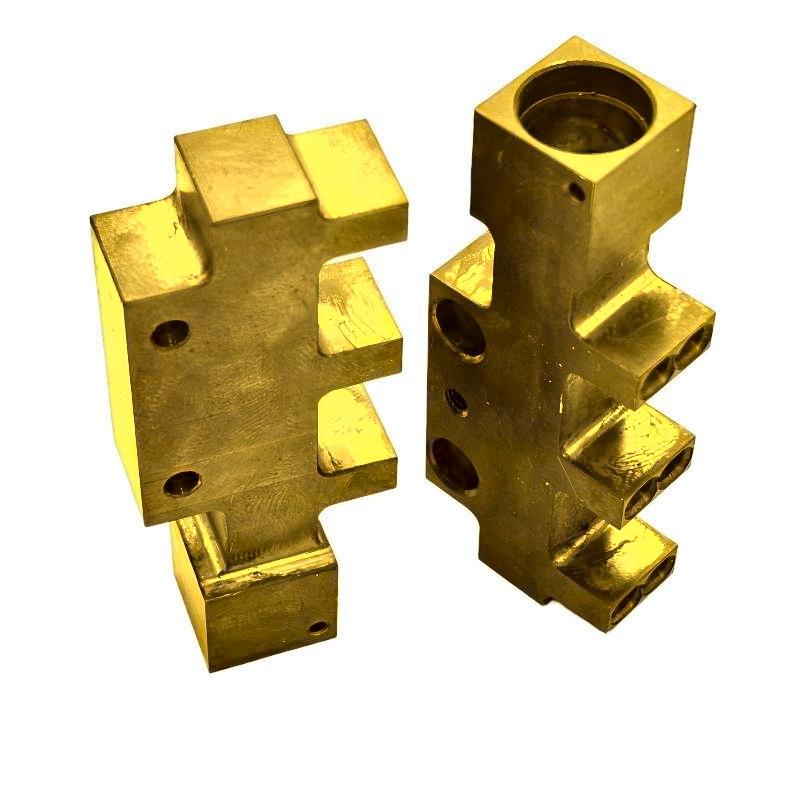
Professional custom-made brass blocks H59 Trustworthy CNC machining mechanical parts
We are a manufacturer integrating industry and trade. We have more than 20 years of experience in production technology. We are located in Dongguan City, Guangdong Province, China.
Core Advantages and Technical Characteristics of CNC Machining of Brass Blocks
I. The Ultimate Pursuit of Geometric Accuracy and Dimensional Stability
1. The most significant advantage of CNC machining of brass blocks lies in its exceptional dimensional accuracy and geometric stability. Using a high-precision CNC milling center, the six right-angle machining of the block can achieve perpendicularity and parallelism control within 0.01mm, and flatness ≤0.005mm/100mm. In the machining of precision measuring instrument bases, this level of accuracy ensures the reliability of the measurement datum, providing a solid foundation for subsequent precision assembly.
2. The precision machining capability of miniature brass blocks is equally outstanding. Using micro-milling technology, miniature brass blocks with sides up to 1mm can be stably machined with a dimensional tolerance of ±0.005mm, and uniform chamfering on all edges. For precision instruments, the high precision of these miniature brass blocks within their small dimensions provides crucial support for instrument miniaturization.
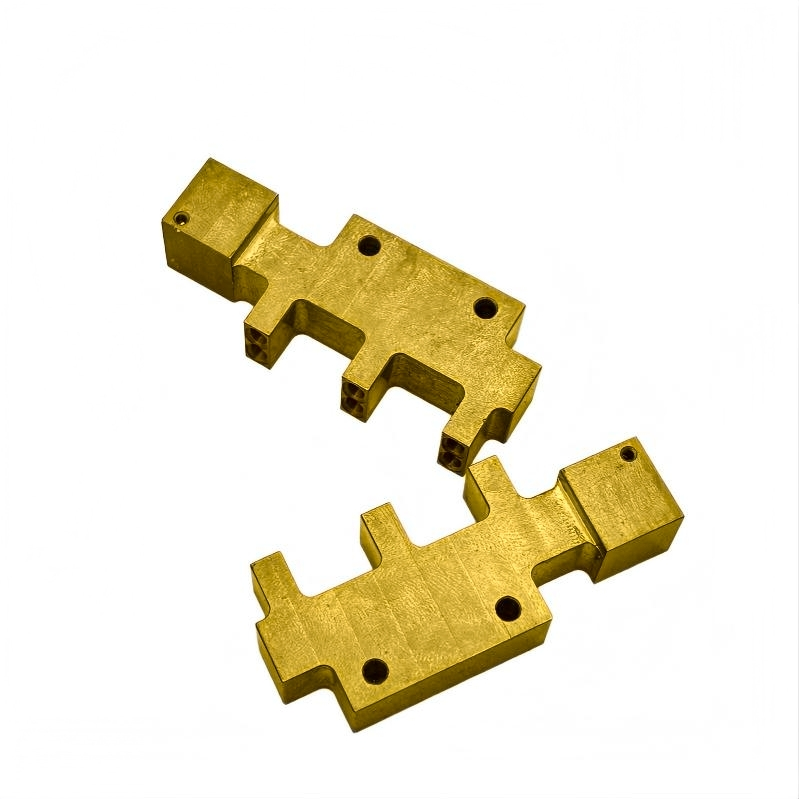
Professional custom-made brass blocks H59 Trustworthy CNC machining mechanical parts
II. Integrated Machining of Complex Structures and Functional Features
1. CNC machining technology has transformed brass blocks from simple hexahedrons into multifunctional integrated substrates. Multiple precision steps of varying heights can be machined from a single piece of brass, with a step height tolerance of ±0.01mm and a relative positional accuracy of 0.015mm between steps. This multi-step structure enables precise mounting of components of different heights in brass substrates used in RF microwave devices.
2. Precise realization of complex three-dimensional surfaces:Through multi-axis simultaneous milling, complex features such as three-dimensional curved surfaces, inclined surfaces, and grooves can be machined on brass blocks, with a surface contour error ≤0.02mm. Brass bases for optical adjustment frames, with features such as V-grooves and arc-shaped guides, are machined in a single operation, providing a stable platform for the precise adjustment of optical components.
3. Full utilization of material properties:
1. Brass materials such as H62 and H65 exhibit excellent cutting performance in CNC machining. Cutting speeds can reach 200-400m/min, with long tool life and a surface roughness of Ra0.4-0.8μm.
2. Full utilization of material uniformity:Brass has a dense and uniform microstructure. CNC machining removes surface defects, allowing for the full utilization of the material's mechanical properties.
III. Surface Integrity and Subsequent Processing Foundation
1. High-quality surfaces obtained through precision machining provide an ideal foundation for subsequent processing. The surface roughness of machined surfaces can be controlled within Ra 0.4-1.6μm, flexibly adjusted according to subsequent process requirements.
2. Efficient Polishing. By optimizing cutting parameters, a near-mirror-like surface finish can be achieved directly during the machining stage, reducing the workload of subsequent polishing.
3. Precise Preparation of Surface Microstructures. Using special toolpaths, regular microtextures can be machined onto the surface of brass blocks with a dimensional accuracy of ±0.005mm. For friction pairs, the surface microtexture of brass blocks improves lubricant retention by 3 times and reduces the coefficient of friction by 25%.
IV. Manufacturing Efficiency and Economic Benefits
1. High-speed cutting technology significantly improves processing efficiency. Cutting speeds for brass can reach 300-500m/min, which is 5-8 times more efficient than stainless steel. 1. The processing time for complex brass blocks, from raw material to finished product, is reduced by 50-70% compared to traditional processes.
2. Material utilization is significantly improved. By optimizing blank dimensions and processing paths, the utilization rate of brass bars and plates increases from 60-70% in traditional processes to 85-90%. Using near-net-shape forging blanks combined with precision machining, the material utilization rate for complex brass blocks can reach over 95%.
3. Tool costs are significantly reduced. Brass material causes less tool wear, extending tool life by 5-10 times compared to processing steel. In mass production, the cost of a single tool is reduced by 60-80%, resulting in a significant overall manufacturing cost advantage.
V. Quality Control and Traceability
1. Full-process digital quality control. The online measurement system automatically detects key dimensions every 50 pieces processed, compensating for tool wear in real time. Coordinate measuring machine (CMM) sampling ensures all features meet design requirements, with a defect rate controlled below 0.3%.
2. Application of 3D digital inspection technology. Three-dimensional data of the brass block was acquired using white light scanning and compared with the design model, achieving an accuracy of 0.01 mm in complex feature error analysis.
With the continuous development of intelligent manufacturing and micro-machining technologies, CNC-machined brass blocks will continue to evolve towards higher precision, miniaturization, and greater functionality.
Company Profile
We are a manufacturer integrating industry and trade. We have more than 20 years of experience in production technology. We are located in Dongguan City, Guangdong Province, China. We have advanced high-end professional production and processing technology, and are committed to innovative R&D and production. After years of market tempering and exploration, it has high-quality technical management personnel, experienced designers, R&D personnel and a perfect company management system cnc precision.
5-axis CNC workshop
Our factory has a plant area of about 2,000 square meters and masters core processing technologies. It has high-end precision production equipment cnc precision: CNC lathes, 5-axis CNC, 4-axis CNC, stamping equipment, die-casting equipment, etc. 2.5-dimensional detection equipment 
two-dimensional testing

cnc precision surface treatment
For surface treatment, our suppliers have been working with us for many years. They have rich experience and are familiar with all the quality requirements of each other. The quality is stable and more guaranteed. Such as: heat treatment, spray painting, powder coating, blackening, silver/gold plating, electrolytic polishing, nitriding, phosphating, nickel/zinc/chromium/TiCN plating, anodizing, polishing, passivation, sandblasting, galvanizing, heat treatment , hardening, laser marking, etc. according to customer requirements. Aluminum alloy surface oxidation
Product Packaging
Packaging Details
- Commercial packaging: 1pc/plastic bag + color box +carton + pallet;
- Industrial packaging: (1). plastic tube + carton + pallet; (2). plastic bag + kraft paper + carton + pallet;
- According to the requirement of customer.

FAQ
Q1: Where can I get product & price information?
A1: Send us an inquiry e-mail, we will contact you once we received your mail.
Q2: How long will I get the sample?
A2: Depends on your specific items, within 3-7 days generally.
Q3: What kinds of information do you need for a quote?
A3: Kindly please provide the product drawings in PDF, if provide in STEP or IGS will be better.
Q4: What are the payment terms?
A4: We accept 50% as a payment deposit, when the goods are prepared, we shoot photos or videos for your check, and then you can pay the balance. For small quantities, we accept Paypal, the commission will be added to the order. For big amounts, T/T is preferred.
Q5: How to deliver the goods?
A5: We deliver the products by courier company.
Q6: Are you a trading company or factory?
A6: We are factory direct with 17 experienced engineers and more than 50 employees as well approximate 3,000m2 workshop area.
Q7: What shall we do if we don't have drawings?
A7: Please send your sample to our factory, then we can copy and provide you better solutions. If send us pictures or drafts with dimensions(Length, Height, Width), CAD or 3D file will be made for you.
Q8: Can we get some samples before mass production?
A8: Absolutely yes.
Q9: Will my drawings be safe after sending them to you?
Q10: Is it possible to know the operation status of my products without visiting your company?
A10: We will offer a detailed production schedule and send weekly reports with digital pictures and videos which show the machining progress.